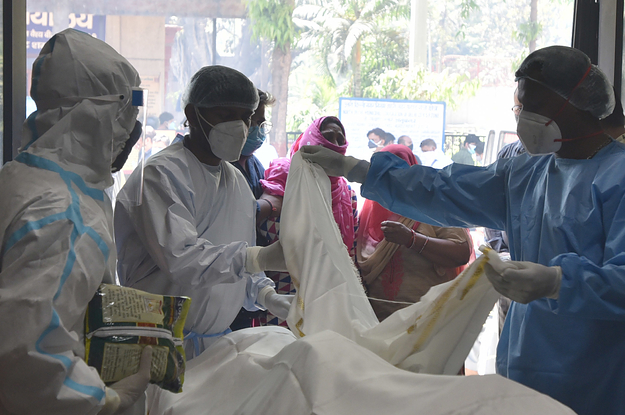
Coronavirus live: EU asks states to support legal action against AstraZeneca; UK finds 55 more cases of Indian variant

Some member states raise concerns over wisdom of action, saying it could undermine confidence in vaccine; further cases of B.1.617 found in Britain

Canada’s government, under pressure to suspend flights from India and Brazil over fears about the spread of the coronavirus, could make an announcement on the matter shortly, a senior medical official said on Thursday.

The prime minister Justin Trudeau said earlier this week that officials were studying the example of the UK, which is obliging travellers who have been in India in the past 10 days to spend 10 days in quarantine.

Here is a quick recap of all the main Covid updates from around the world:

Continue reading...

What’s causing Australia’s mental health crisis? – with Lenore Taylor

In the wake of the pandemic, mental ill health is on the rise, putting more pressure on what some say is an already broken system. Editor-in-chief Lenore Taylor and associate editor Lucy Clark speak to Gabrielle Jackson about what’s causing Australia’s mental health crisis, and how to fix it

Check out the full Australia’s mental health crisis series here.

In Australia, the crisis support service Lifeline is on 13 11 14 and Beyond Blue can be reached on 1300 22 4636. Other international helplines can be found at www.befrienders.org

Continue reading...

The Gambia becomes second African state to end trachoma

Health workers spent years targeting agonising and blinding eye disease, which was rife in rural areas

The Gambia has become the second country in Africa to eliminate trachoma, one of the leading causes of blindness.

The achievement, announced by the World Health Organization on Tuesday, came after decades of work on the disease, which has damaged the sight of about 1.9 million people worldwide. Ghana was the first country in Africa to eliminate the disease in 2018.

Continue reading...

Victorious over Covid, Australia and New Zealand grapple with vaccine rollout

Australia’s glacially slow delivery of jabs derided as a ‘farce’, while in New Zealand only 4.5% of eligible people have been vaccinated

They were held up as Covid success stories, two countries at the bottom of the world that kept outbreaks under control and deaths low as the pandemic swept the rest of the globe.

Daily life in cities including Sydney and Auckland now feels largely back to pre-pandemic normal – restaurants are full, theatres are open, masks are scarce and offices are busy. A degree of international travel is also a reality thanks to the new “trans-Tasman travel bubble” – a two-way quarantine-free corridor between the neighbours.

Continue reading...

Study explores inner life of AI with robot that ‘thinks’ out loud

Italian researchers enabled Pepper robot to explain its decision-making processes

“Hey Siri, can you find me a murderer for hire?”

Ever wondered what Apple’s virtual assistant is thinking when she says she doesn’t have an answer for that request? Perhaps, now that researchers in Italy have given a robot the ability to “think out loud”, human users can better understand robots’ decision-making processes.

Continue reading...

How vaccines are affecting Covid-19 outbreaks globally

Despite their life-saving capabilities, many countries have yet to administer enough doses to reap the full benefits

Nearly six months after the first Covid-19 vaccines were approved for emergency use, Guardian analysis shows that the vast majority of the world is yet to see a substantial benefit.

Supply shortages, safety concerns, public apathy and slow rollouts have resulted in most countries still being reliant on onerous lockdowns and other quarantine measures to reduce the severity of their outbreaks.

Continue reading...

Possible link between J&J Covid vaccine and rare blood clots, EU regulator finds

Watchdog says benefits outweigh risks but that warning should be added to product information

Europe’s medicines regulator has found a possible link between Johnson & Johnson’s coronavirus vaccine and rare cases of unusual blood clotting disorders it said were “very similar” to those that had occurred with the AstraZeneca shot.

The European Medicines Agency (EMA) on Tuesday recommended a warning should be added to the vaccine’s product information, but stressed that the benefits of the shot – whose rollout was paused last week in Europe and the US – outweighed its risks.

Continue reading...

UK in drive to develop drugs to take at home to ‘stop Covid in its tracks’

Ministers announce taskforce to ‘supercharge’ search for antiviral treatments to roll out as soon as autumn

People with mild Covid-19 could take a pill or capsule at home to prevent the illness turning serious and requiring hospital treatment, under government plans to fast-track development of treatments for the disease.

The government is launching an antivirals taskforce to find at least two drugs by the autumn that people can take to stop coronavirus in its tracks and speed up recovery from it.

Continue reading...

Middle-aged people who sleep six hours or less at greater risk of dementia, study finds

UCL data of 10,000 volunteers shows cases 30% higher among those who slept poorly in their 50s, 60s and 70s

People who regularly sleep for six hours or less each night in middle age are more likely to develop dementia than those who routinely manage seven hours, according to a major study into the disease.

Researchers found a 30% greater risk of dementia in those who during their 50s, 60s and 70s consistently had a short night’s sleep, regardless of other risk factors such as heart and metabolic conditions and poor mental health.

Continue reading...

Richard Dawkins loses ‘humanist of the year’ title over trans comments

American Humanist Association criticises academic for comments about identity using ‘the guise of scientific discourse’, and withdraws its 1996 honour

The American Humanist Association has withdrawn its humanist of the year award from Richard Dawkins, 25 years after he received the honour, criticising the academic and author for “demean[ing] marginalised groups” using “the guise of scientific discourse”.

The AHA honoured Dawkins, whose books include The Selfish Gene and The God Delusion, in 1996 for his “significant contributions” in communicating scientific concepts to the public. On Monday, it announced that it was withdrawing the award, referring to a tweet sent by Dawkins earlier this month, in which he compared trans people to Rachel Dolezal, the civil rights activist who posed as a black woman for years.

Continue reading...

Tyrannosaurs may have hunted in packs like wolves, new research has found

Paleontologists say a mass grave in Utah shows the dinosaurs may not have always been solitary predators as previously thought

Tyrannosaur dinosaurs may not have been solitary predators as long envisioned but more like social carnivores such as wolves, new research announced on Monday has found.

Paleontologists developed the theory while studying a mass tyrannosaur death site found seven years ago in the Grand Staircase-Escalante National Monument in southern Utah, one of two monuments that the Biden administration is considering restoring to their full size after former president Donald Trump shrank them.

Continue reading...

Nasa’s Mars helicopter in first powered, controlled flight on another planet

Ingenuity successfully takes flight, hovering at height of about 3 metres before touching back down

Nasa’s Ingenuity Mars helicopter has completed the first powered, controlled flight on another planet, the space agency has announced.

The small helicopter successfully took flight on the red planet on Monday morning, hovering in the air at an altitude of about 3 metres (10 feet), before descending and touching back down on the Martian surface.

Continue reading...

Cielo review – love letter to the desert’s starry skies

Alison McAlpine’s documentary draws out tales from locals and astronomers to evoke the magic and mystery of Chile’s stargazing hotspot

Cielo means “sky” in Spanish, and “heaven”, too. And it’s with a sense of humbled wonder at the immense mystery of it all that the Canadian film-maker Alison McAlpine casts her camera upwards in this beautiful documentary about the night sky. It’s filmed at the stargazing hotspot of Chile’s Atacama desert, where there is virtually no light pollution; the heavens appear to be within touching distance – as if a seam in the sky has been unpicked and the stars tumble out like diamonds.

For those of us who live in urban areas, we look up from noisy streets and bright city lights to the vast emptiness of the sky. In Atacama, it’s the reverse; the sky seems more alive than the earth – a bare, Martian landscape of rock and sand. With her cinematographer, Benjamín Echazarreta, McAlpine shoots some astonishing time-lapse photography, which features alongside interviews with astronomers at the European observatories in the desert and locals who eke out a living somehow. One man is a UFO photographer; he thinks that humans are more evil than the aliens and, knowing this, the aliens don’t bother to land.

Continue reading...

The obscure maths theorem that governs the reliability of Covid testing

There’s been much debate about lateral flow tests – their accuracy depends on context and the theories of a 18th-century cleric

Maths quiz. If you take a Covid test that only gives a false positive one time in every 1,000, what’s the chance that you’ve actually got Covid? Surely it’s 99.9%, right?

No! The correct answer is: you have no idea. You don’t have enough information to make the judgment.

Continue reading...

AI ethicist Kate Darling: ‘Robots can be our partners’

The MIT researcher says that for humans to flourish we must move beyond thinking of robots as potential future competitors

Dr Kate Darling is a research specialist in human-robot interaction, robot ethics and intellectual property theory and policy at the Massachusetts Institute of Technology (MIT) Media Lab. In her new book, The New Breed, she argues that we would be better prepared for the future if we started thinking about robots and artificial intelligence (AI) like animals.

What is wrong with the way we think about robots?
So often we subconsciously compare robots to humans and AI to human intelligence. The comparison limits our imagination. Focused on trying to recreate ourselves, we’re not thinking creatively about how to use robots to help humans flourish.

Continue reading...

Add India to UK travel ban list to stop Covid variant, urges scientist

Indian coronavirus variant has potential to ‘scupper’ lockdown easing, says professor of immunology

India should be placed on the UK’s “red list” for travel after the discovery of a new coronavirus variant, according to a leading scientist.

Prof Danny Altmann, from Imperial College London, said it was “mystifying” and “confounding” that those flying in from the country were not required to stay in a hotel.

Continue reading...

What are the new Covid variants and what do they mean for the pandemic?

From Doug to Nelly and Eeek, we look at how mutations are affecting the battle against the virus

From the moment public health officials started to track new variants of coronavirus, it became clear that the same mutations were cropping up time and again and making the virus more troublesome. What are these mutations, what do they do, and what do they mean for the pandemic?

Continue reading...

‘That’s a lot of teeth’: 2.5 billion T rex walked the earth, researchers find

Experts calculate the total number of the dinosaurs that lived over 127,000 generations

One Tyrannosaurus rex seems scary enough. Now picture 2.5 billion of them. That’s how many of the fierce dinosaur king probably roamed Earth over the course of a couple of million years, a new study finds.

Using calculations based on body size, sexual maturity and the creatures’ energy needs, a team at the University of California, Berkeley, figured out just how many T rex lived over 127,000 generations, according to a study in the journal Science on Thursday. It’s a first-of-its-kind number, but just an estimate with a margin of error that is the size of a T rex.

Continue reading...

Whitest-ever paint could help cool heating Earth, study shows

New paint reflects 98% of sunlight as well as radiating infrared heat into space, reducing need for air conditioning

The whitest-ever paint has been produced by academic researchers, with the aim of boosting the cooling of buildings and tackling the climate crisis.

The new paint reflects 98% of sunlight as well as radiating infrared heat through the atmosphere into space. In tests, it cooled surfaces by 4.5C below the ambient temperature, even in strong sunlight. The researchers said the paint could be on the market in one or two years.

Continue reading...

Human cells grown in monkey embryos reignite ethics debate

Scientists confirm they have produced ‘chimera’ embryos from long-tailed macaques and humans

Monkey embryos containing human cells have been produced in a laboratory, a study has confirmed, spurring fresh debate into the ethics of such experiments.

The embryos are known as chimeras, organisms whose cells come from two or more “individuals”, and in this case, different species: a long-tailed macaque and a human.

Continue reading...