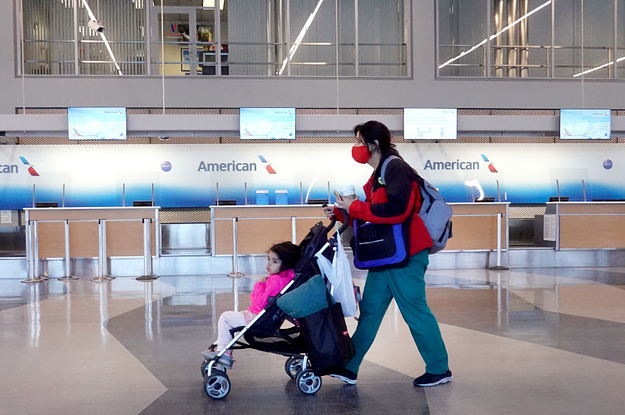
But as COVID-19 cases rise nationwide, “I would advocate against general travel overall,” CDC Director Rochelle Walensky said on Friday.
Country has registered more than 12.9 million cases; 10,000 appointments scrapped, reports Dutch news agency citing Netherlands health ministry
That’s it from the global blog team for now. Thanks for following our coverage, a new blog will be going live in a few hours.
Continue reading...
Government commitment to Horizon Europe fund averts immediate threat to science, say universities
The government has stepped in at the 11th hour with an additional £250m in funding to help pay for the UK’s association with Horizon Europe, the European Union’s funding programme for research and innovation.
Universities welcomed the move as “a significant affirmation of the government’s belief in research” which would avert the immediate threat to UK science.
Continue reading...The team behind Once Upon a Time in Iraq has compiled a moving and sometimes hopeful three-parter that offers a global perspective on the crisis
Like the virus itself, the programmes about it have moved from localised subjects to a slightly wider field and now have expanded to take in a global view. It hasn’t been a perfectly linear progression, of course, but most of the first documentaries were composed largely of footage recorded by medical professionals themselves, at work and then – exhausted and tearful – at home.
After that came socially distanced films recording the impact on local communities and bereaved families, the experiences of survivors and the long-term consequences for those who do not make a full recovery. Alongside that have come considerations and critiques of the UK response to the crisis and comparisons – not generally favourable – with that of other countries.
Continue reading...Findings based on two doses three weeks apart are first to show shot remains effective for many months
The coronavirus vaccine developed by Pfizer and its German partner BioNTech protects against symptomatic Covid for up to six months, an updated analysis of clinical trial data has found.
In a statement released on Thursday, the companies reported efficacy of 91.3% against any symptoms of the disease in participants assessed up to six months after their second shot. The level of protection is only marginally lower than the 95% achieved soon after vaccination.
Continue reading...
Study by Office for National Statistics based on data from blood test results
Half of people in the UK now have antibodies against coronavirus, either through infection or vaccination, tests conducted by the Office for National Statistics (ONS) show.
According to the most recent coronavirus infection survey, an estimated 54.7% of the population in England would have tested positive for antibodies to coronavirus from a blood sample in the week ending 14 March 2021.
Continue reading...Commission security proposal would restrict UK access to Horizon Europe quantum computing project
Britain will join China in being locked out of research with the EU on cutting-edge quantum technology, such as new breeds of supercomputers, due to security concerns under a European commission proposal opposed by academics and 19 member states.
At a meeting on Friday, commission officials said the EU needed to keep control of intellectual property on key projects and that working with even close allies such as the UK and Switzerland opened up an unacceptable risk.
Continue reading...Spasms, memory loss and hallucinations among symptoms of 43 patients in Acadian region of New Brunswick province
Doctors in Canada are concerned they could be dealing with a previously unknown brain disease amid a string of cases involving memory loss, hallucinations and muscle atrophy.
Politicians in the province of New Brunswick have demanded answers, but with so few cases, experts say there are far more questions than answers and have urged the public not to panic.
Continue reading...Immunisation panel says there is ‘substantial uncertainty about the benefit’ of the vaccine given risk of rare type of blood clot
Canada on Monday suspended the use of the Oxford/AstraZeneca coronavirus vaccine for people under 55 following concerns it might be linked to rare blood clots.
The pause was recommended by the National Advisory Committee on Immunization for safety reasons. The Canadian provinces, which administer health in the country, announced the suspension on Monday.
Continue reading...Suicide rates among Japanese women rose sharply during the pandemic, prompting calls for support for low-income households
The coronavirus had barely begun its surge across the globe when Ayako Sato was told that the nursery where she worked would temporarily close as part of Japan’s efforts to curb the outbreak.
The mother of two teenage daughters expected a few weeks of belt tightening, believing it wouldn’t be long before she was working again.
Continue reading...The importance of a beacon and having fortitude are key for lighthouse keepers – clues for us all when there’s little else around
Imagine being a lighthouse keeper. Before I dropped beneath the surface of this secluded, often secretive, occupation, the idea brought to mind wind-blown seagulls, or a bearded sea dog chewing his pipe. Such is the romantic notion many of us have about lighthouses. The reality is (or was, because the staffed lighthouse is now extinct) quite different.
Land lights – those charming beacons you’ll find on the coast, the distinctive red stripe of Portland Bill or the thimble-shaped watchpoint at Llanddwyn – are appealing, but for me the sea towers hold the greatest allure. I’m talking about those majestic, improbable stations rising audaciously up out of the ocean – the Bell Rock, the Bishop, the Longships. The famous Eddystone, south of Plymouth, is the fourth built on that reef, in an effort that spanned almost 200 years. Its neighbouring “Smeaton’s Stump”, the remains of a third manifestation, serves as a stark reminder that water is not meant to hold buildings.
Continue reading...Here are the current coronavirus hotspots and case locations in Queensland and what to do if you’ve visited them
Queensland authorities have released a list of hotspots where Covid-positive people have visited while infectious.
Any individuals who have been in the below locations during the relevant times are considered close contacts and asked to immediately home quarantine (for 14 days), even if you receive a negative result, and complete the contact-tracing self-assessment or call 13HEALTH (13 43 25 84):
Continue reading...Chunk of space rock was once the ‘poster child for hazardous asteroids’ but it will be a while before humans need to worry about it again
Nasa has given Earth the all clear on the chances of an asteroid called Apophis hitting our planet any time in the next century, having worried space scientists for over 15 years.
The 340-metre (1,100ft) chunk of space rock hit the headlines in 2004 after its discovery led to some worrying forecasts about its orbit. It became a “poster child for hazardous asteroids”, according to one Nasa expert.
Continue reading...Leap of 50% in cases in three months and just 7m jabs across continent ‘infecting 11 health workers an hour’
Rising cases of coronavirus in Africa threaten to overrun fragile healthcare systems and test the continent’s much-touted resilience to the disease, according to the World Health Organization’s regional office for the continent.
The global health body stated that infections were on the rise in at least 12 countries in Africa including Cameroon, Ethiopia, Kenya and Guinea.
Continue reading...All options to fight climate crisis must be explored, says national academy, but critics fear side-effects
The US should establish a multimillion-dollar research programme on solar geoengineering, according to the country’s national science academy.
In a report it recommends funding of $100m (£73m) to $200m over five years to better understand the feasibility of interventions to dim the sun, the risk of harmful unintended consequences and how such technology could be governed in an ethical way.
Continue reading...The monotony of lockdown life has starved us of spontaneity and serendipity, which enhance learning and memory
I hit a wall in late February and felt that life had taken on a quality of stultifying sameness. Was it Wednesday or Sunday? I couldn’t really tell: every day of the week felt identical because there was nothing to distinguish them. Work, read, exercise, eat, repeat. Like nearly everyone I know, I have settled into a state of dreary uniformity.
The pandemic has been a vast uncontrolled experiment – not just in social isolation, which is bad enough, but in the deprivation of novelty. Overnight we were stripped of our ability to roam around our world the way we usually do. Gone were the chance encounters with other people and the experience of new things and places: no travel, no adventures, no restaurants, no theatres, no crowds. We weren’t just quarantined from Covid: we were cut off from the ubiquitous stimulation of the unfamiliar and new.
Continue reading...A majority of menstruating women have experienced changes to their cycle over the last year, surveys suggest. One of the main culprits? Persistent stress
We will not look back on the past year as a vintage one for the human body. Since March 2020, many of us have experienced physical manifestations of stress that correspond to living through a global pandemic. From low energy and headaches to changes in mood and disrupted sleep, our rhythms are deeply upset. And many women have experienced changes to a fundamental rhythm: the menstrual cycle.
Rachel Burns has always experienced premenstrual syndrome (PMS), but it has been even more difficult to navigate in the past 12 months. “I always have a few days of feeling quite withdrawn before my period, but this has morphed into me feeling unreachable and anxious for over a week,” says the 36-year-old from Kent. “My partner says the change is significant.” Before Christmas, her PMS made her feel as if she were “going mad, like a panic attack I couldn’t come down from”. The effects of her period drag on now. She feels fluey, achy, “completely depleted, physically and emotionally”. As a result, it can feel like she “only has one ‘good’ week” a month. “It’s like being at sea within yourself,” she says.
Continue reading...No exports were made on Thursday; Belgium imposes fresh lockdown; Iceland imposes three-week shutdown; France locks down more areas
AstraZeneca has dismissed as “inaccurate” a report in the Italian press that 29m doses of its Covid-19 vaccine found in factory near Rome were destined for the UK.
La Stampa reported on Wednesday that the doses – almost twice the amount the EU has so far received from AstraZeneca – were found “hidden” in the factory following a search by Italian police on Saturday at the request of the European commission, and that they were probably destined for the UK.
Related: AstraZeneca dismisses claim 29m vaccine doses in Italy were bound for UK
Luxembourg has announced a partial reopening of its hospitality industry, with cafés and restaurants able to serve customers again in outdoor areas from 7 April.
The European country’s venues have been closed since the end of November.
Continue reading...Molecular switch makes human organ three times larger than great apes’, study finds
It is one of the defining attributes of being human: when compared with our closest primate relatives, we have incredibly large brains.
Now scientists have shed light on the reasons for the difference, by collecting cells from humans, chimps and gorillas and turning them into lumps of brain in the laboratory.
Continue reading...